
Sri Lankan Railway Network
 download map
Railway network download map
Length of track (1996 figures)
Total 1,463 km
Broad gauge 1,404 km 1676 mm (5 ft 6 in) gauge
Narrow gauge 59 km 2 ft 6 in (762 mm) gauge(1996)
Total 1,463 km
Broad gauge 1,404 km 1676 mm (5 ft 6 in) gauge
Narrow gauge 59 km 2 ft 6 in (762 mm) gauge(1996)
West German, Henschel-Thyssen, General Motors V12 12-645E (2 stroke) locomotive in Colombo-Kandy railroad track. Sri Lanka Government Railway operates the country’s railway
network, which includes about 1450 km (901 mi) of track. Colombo is the main node of the network, and train routes connect the main cities of all nine provinces in the country.
Most of the railways were developed during the British colonial period, with the first line from Colombo to Kandy opening on 26 April 1867. The British introduced the railway as a cheap means of transporting the goods produced in the British-owned tea, rubber and coconut
plantations, situated away from the main port in Colombo. Hence, the legacy rail network was suited for the distribution from plantations. After independence from Britain, the Sri Lankan economy became focused more on industries than plantation agriculture. The road network also grew, and with the introduction of lorries, which were a faster means of transporting goods, the amount of goods transported by the railways declined. As the railway network is more focused on plantation areas and not on population and service centres, the railways
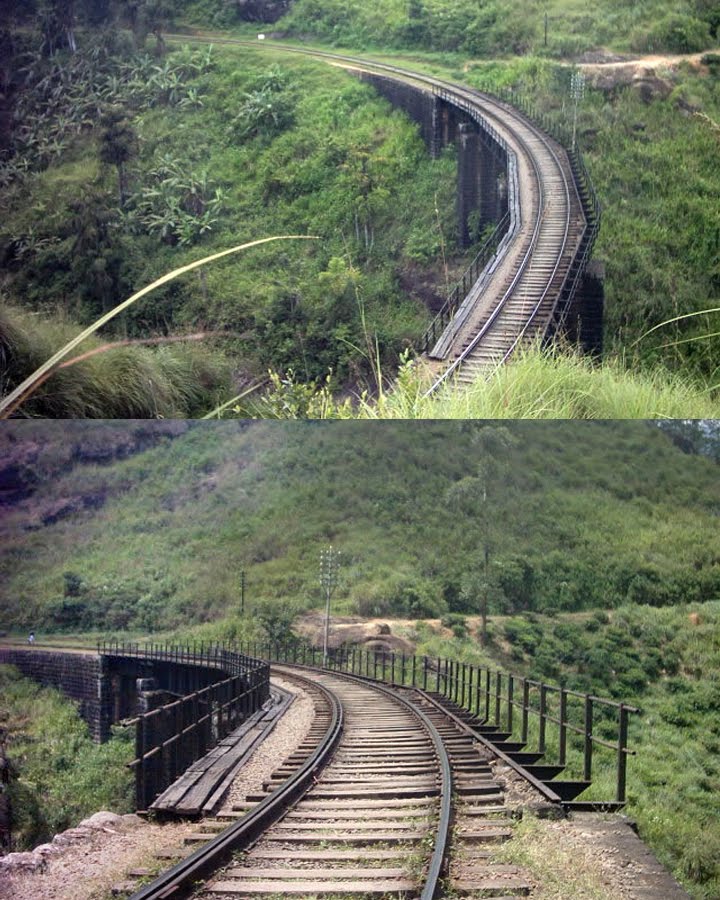
have become an enterprise generating a heavy loss. The Sri Lankan railway network covers one of the most scenic landscapes in the world, the best of which is the Colombo-Badulla main line which runs hugging the steep mountains of the Sri Lankan highlands. The railways connect the main cities of Kandy, Galle, Matara, Anuradhapura, Gampaha, Negombo, Kurunegala, Avissawella, Kalutara, Polonnaruwa, Batticaloa, Trincomalee, Badulla, Gampola,
Nawalapitiya, Matale, Vavuniya, Puttalam and Chilaw with the Capital Colombo. The lines to Jaffna, Kankesanturai and Mannar have been destroyed by the LTTE. There were also narrow gauge lines from Nanu Oya to Nuwara Eliya, Avissawella to Yatiyantota and Avissawella to Ratnapura and Opanayaka, which were dismantled due to financial losses from their operation.
Note that the narrow-gauge Kelani Valley Line, from Colombo to Avissawella is not functioning anymore, there is a broad gauge track in its place now. In the 1970s the bridges and culverts on the line were strengthened to make thechange to broad gauge, but the actual conversion was not made until the 1990s. The potential for expansion was revealed when Minister of Transport Leslie Goonewardena opened an extension of the Coastal Line from Puttalam to Aruvakalu in 1974, to service the cement factory there. Cargo traffic increased immediately by about 40% by tonnage. A new line from Matara to Tissamaharama has been started. In 2005 a new government ministry was established to oversee railway expansion.

download map
********************************************
Railway routes
********************************************
Railway routes
- Main Line – Colombo to Badulla.
- Matale Line from Peradeniya junction to Kandy and Matale. Udupussellawa Line (narrow gauge) from Nanu Oya junction to Ragala via Nuwara Eliya - Track abandoned in 1940.
- Southern Line – (Better known as Coast Line)- Colombo to Matara via Galle - extension ofthe track up to Hambantota and Kataragama is currently under construction.
- Northern Line – Colombo to Kankesanturai deviates from the Main Line at Polgahawela junction - presently operating only up to Thandikulam, track was abandoned from Vavuniya due to war. Reconstruction began in March 2009 to re-extend track up to Kankesanthurai. Mihintale Line from Anuradhapura to the sacred city of Mihintale
- Batticaloa Line separates from the Northern Line at Maho junction and extends up to Batticaloa via Polonnaruwa.
- Tricomalee Line from the Batticaloaline at Gal-oya junction in the to Trincomalee.
- Puttalam Line – Colombo to Puttalam - deviates from the Main Line at Ragama. Industrial Line from Puttalam to Aruwakalu and Ilavankulam via Vanathavillu.
- Kelani Valley Line (narrow gauge) - Colombo to Yatiyantota - presently operating only up to Avissawella, the track to beyond Avissawella was abandoned in 1940. Broad gauged up to Avissawella in 1997. Sabaragamuwa Line (Narrow Gauge) from Avissawella to Opanayaka via Ratnapura - Track abandoned in 1970.
- Mannar Line (Earlier Indo-Lanka Line) Colombo to Talaimannar - Divides from Northern Line at Madawachchi junction - Not operational - track abandoned due to terrorist activities.




.JPG)
.jpg)
.jpg)

.jpg)
.jpg)
.JPG)
.JPG)

.jpg)
.jpg)


.jpg)
.JPG)
.jpg)